From the Amalfi Coast to Mallorca, the hotels that take the game seriously, with courts below a castle in Umbria and on the shores of Lake Como.
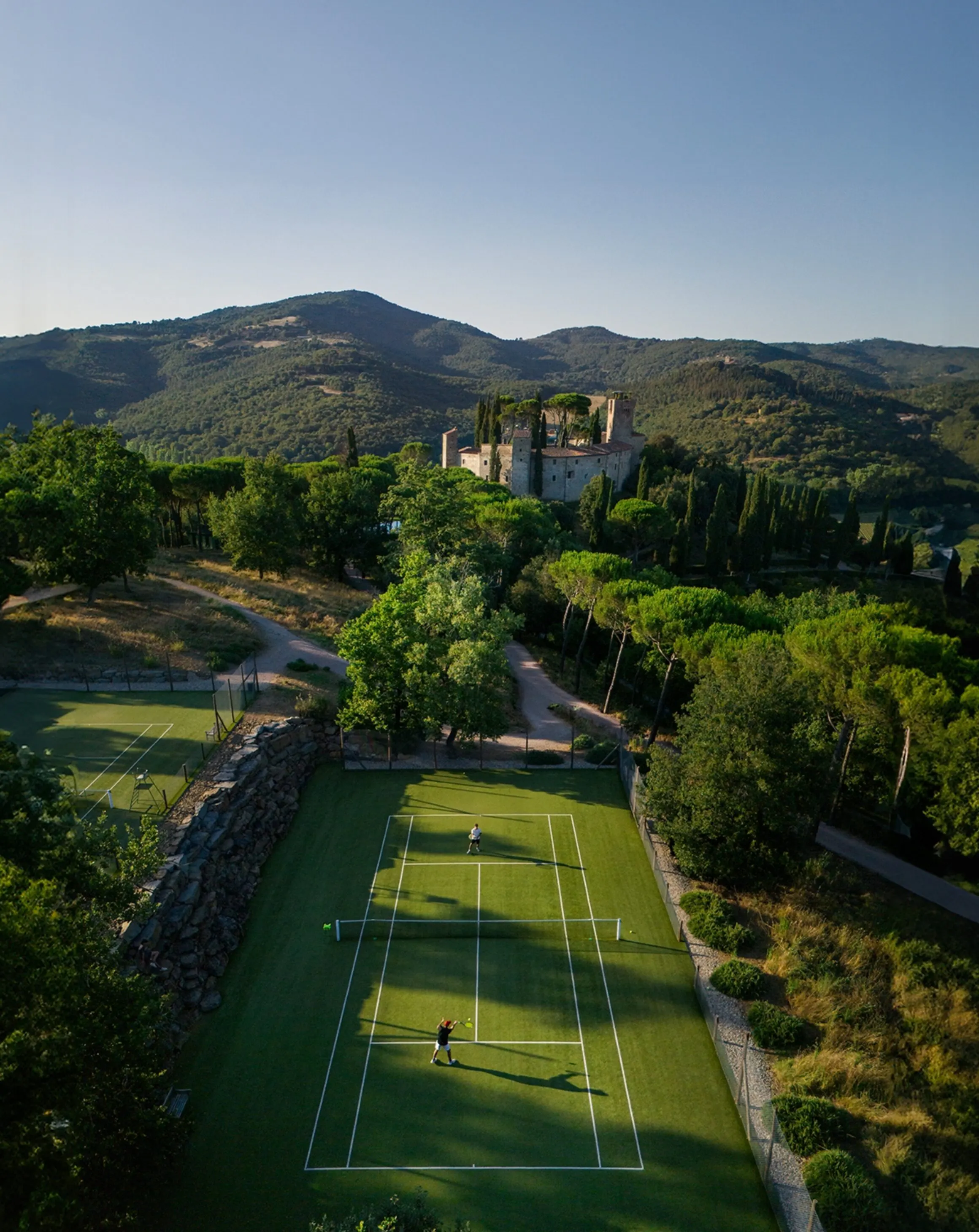
The grass court below the castle at Reschio, in the hills of Umbria. Photo: Reschio
A good court is its own reason to travel. The ones here are cut into the rock below Positano, laid in grass beneath a castle in Umbria, and set among the pines of Cap d’Antibes in the grounds of the Hôtel du Cap-Eden-Roc. Some are more than a century old, from when a court was as much a part of a summer address as the terrace.
What they have in common is that the hotel treats the game as part of the place rather than an amenity. Courts are kept properly, a pro is on hand, and there is somewhere to sit afterwards with a view. For a trip planned around playing, these are the addresses to start with.
Two grass courts laid out below a thousand-year-old castle in the hills where Umbria meets Tuscany, hedged in stone and cypress, with a pavilion beside them for a drink between sets. The courts are kept as carefully as the castle above them, reserved for guests, with private coaching booked through the hotel. The Bolza family bought the estate in 1994 and opened the castle as a hotel of 36 rooms and suites in 2021.
The most photographed court in Italy, cut into the cliff above the sea and reached by an elevator through the rock. It sits on its own ledge at the water’s edge, with the beach club a few steps away and nothing but sea beyond the fence. The court is kept for guests and a trainer can be arranged. The Cinque family opened the hotel in 1970 and still runs it, with 56 rooms and suites stepping down the cliffside, a Michelin star at Zass, and boats that leave daily along the Amalfi Coast.
A single court at the edge of a private two-hectare peninsula at Èze-Bord-de-Mer, between Monaco and Nice, with the sea on three sides of the baseline. One court for 28 rooms and suites means it is rarely shared, and a morning game can be followed by a swim from the rocks below. The hotel began as a villa in 1899 and keeps a private beach and jetty, two pools, and a Michelin star at La Table du Cap Estel.
From around €2,000 a night. Book through Cap Estel.
Cap Estel on its peninsula at Èze, the court beside the water. Photo: Cap Estel
Five clay courts shaded by pines, palms and olive trees in the nine-hectare park at the legendary hotel at the tip of Cap d’Antibes, with coaching on request and the sea a short walk through the gardens. Play early, before the heat, then walk down through the pines to the saltwater pool cut into the rock. The hotel dates back to 1870 and has 111 rooms and suites, four villas, and a Michelin star at Louroc.
A red clay court from 1910, the year the hotel opened, hedged with jasmine on the western shore of Lake Como and lit for evening play, when the mountains go pink across the water. The De Santis family have owned the Art Nouveau palace since 1975 and keep its 90 rooms and suites in period, with three pools in the gardens, one of them floating on the lake.
The clay court above the lake at Grand Hotel Tremezzo. Photo: Grand Hotel Tremezzo
Grand Hotel Villa Serbelloni
Two courts hidden in the park above Bellagio, reached by a path through the gardens with the lake opening out below. They sit on the point where the two arms of Lake Como meet, which is the view from the baseline, and the walk back down ends at the pool on the water. The villa was built in the 1850s, became a hotel in 1873, and has been run by the Bucher family since 1918, with 95 rooms and suites and a Michelin star at Mistral.
A single court cut into the hillside above Portofino, with a pro on staff and yachts moored in the bay below. Play in the morning before the village fills, then take lunch on the terrace with the water beneath you. The hotel began as a sixteenth-century monastery, opened in 1901, and is being renewed room by room by Martin Brudnizki, with around seventy rooms and suites, a heated saltwater pool, and La Terrazza for dinner as the lights come on around the harbour.
A clay court on the lowest terrace of the gardens at Moltrasio, which seems to hang over Lake Como and has been called the infinity court for it. The mountains on the far shore stand behind every serve, and the boats pass close enough below to watch between points. The villa was built in the eighteenth century for Count Andrea Lucini Passalacqua, Bellini composed here in 1829, and the De Santis family reopened it as a hotel of 24 suites in 2022, with the spa in the old tunnels beneath the house and boats leaving from a private jetty.
Two sunken courts and two padel courts set among the olive trees and umbrella pines on the hill above Pampelonne, reached by a short walk or by golf cart from the château, with coaches on request and changing rooms courtside. Sunk below the level of the grounds and shaded by the pines, they stay cool and out of the wind. The nineteenth-century château has been a hotel since 1904 and reopened under Airelles in 2021 with 86 rooms and suites, twelve hectares of grounds, and its own beach club at Jardin Tropezina.
A sunken court among the pines at Château de la Messardière. Photo: Airelles
Il Borro
Two courts laid out among the vineyards and olive groves of the Ferragamo family’s estate near Arezzo, with instructors on the property and the medieval village of Il Borro on the hill above. The courts sit in the open Tuscan light with the valley for a backdrop, and a set here ends with a glass of the estate’s own wine. Ferruccio Ferragamo bought the near-derelict borgo in 1993 and restored it into a working estate with suites in the village houses, an organic winery, and a spa.
Two hard courts set among the olive and citrus groves below the Tramuntana mountains, with a resident coach and the village of Deià a short walk down the hill. The mountains close in behind the baseline and the sea shows between them. Two sixteenth-century manor houses make up the hotel, which Richard Branson brought back to life in the 1980s and Belmond now runs, with 70 rooms and suites, sculptures through the gardens, a spa, and El Olivo in the old olive press.
The court below the Tramuntana at La Residencia, Deià. Photo: Belmond
When to go
The season runs from April to the end of October, and most of these hotels close for the winter in between. April to June and again in September and October are the months to come, when the courts are open all day and the afternoons are long without the heat. In July and August book the court for first thing in the morning or the last hour of light. Pack a racquet or borrow one from the pro shop. The game does not change from one court to the next. What changes is what you see over the net, and nowhere is that better than on these courts.